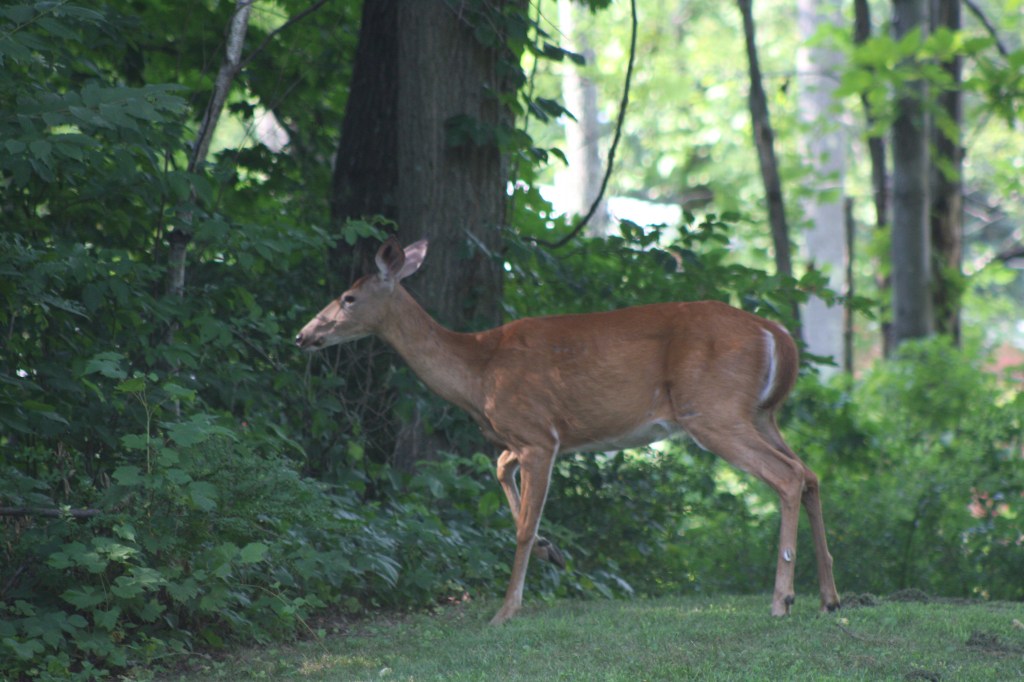
Another piece of the perfect storm of ticks my family and I found ourselves in when we moved 6 miles from where I was born was the wildlife and how much they would impact the tick danger. There are many wildlife species that can help facilitate the spread of ticks. Here in the Northeastern US, white tailed deer and white footed mice are the often cited most likely culprits for spreading the disease, quickly followed by other wildlife like certain wild birds, chipmunks, racoons, squirrels, and many more. Another that has only been added to the list of species proven to increase the danger of tick born disease is the black bear. Some wildlife don’t carry the pathogens but help the ticks move around while other wildlife has been found to increase how many ticks are carrying pathogens and also helping transport ticks.
When I first moved to my new home, I knew the area had a lot of wildlife. I knew there were black bears that called the State Park home. But I didn’t quite realize the extent of the black bear interactions until after I had moved in, and hung a bird feeder way down the eve of my house off of a gutter. (Now I don’t feed the wild birds because they bring more ticks in addition to the bears) in the morning, a bear had somehow managed to climb the distance to the feeder and pull it down from the gutter where I thought it was safe. My kids would be waiting for the school bus early in the morning, and a bear would often happen by, just taking an early morning stroll down the road. they were very frequent visitors, and we started to notice that they too were carrying ticks.

We learned to store our chicken feed inside our home instead of anywhere outdoors, and we learned not to feed the chickens in a feeder when this guy started coming to check for the feeders themselves. Instead, from this moment on, we fed our chickens only enough for them to consume in a short time, and always straight on the ground.
I was always surprised that I couldn’t find any information proving that bears help the spread of ticks and disease, that they were never mentioned. But in 2021, Penn State University did a study published in the International Journal for Parasitology: Parasites and Wildlife, found that nearly 71% of bears examined had ticks present, all of which were blacklegged ticks.1 Researchers also found that “All three life stages of tick were found on bears during the study. The surveys indicated that the head and front-quarters of bears are more likely to be parasitized by adult ticks, while the legs and toes are more frequently parasitized by immature ticks—nymphs and larvae. In particular, the toes, a body area often overlooked in tick research on medium-sized and large mammals, were parasitized nearly exclusively by immature ticks. “To our knowledge, this is the first report of larval blacklegged ticks being found on black bears,” Tiffin said. “Immature blacklegged ticks typically have been thought to feed primarily on small and medium-sized mammals, but our results show that immatures of this species feed on large mammal hosts as well.””. For this article, I was trying to find the actual number of bears that are reported to live in the park behind me, but I couldn’t find it. But according to the Department of Environmental Conservation, Minnewaska has the largest population of black bears in the state of NY.2 They state, “It has one of the highest black bear densities of any part of the state – an estimated .79 bears per square mile.” The bears, like the land use and the invasive plants, are proven to increase the tick burden of a given area.
Wild birds are considered a tremendous spreader of ticks. Research has found the danger level can depend on the species. Some birds can only move ticks from place to place or give a tick a blood meal and move it to a different place while still other birds can do that and also spread and carry the pathogens themselves. Lyme disease ,org notes that “Species from the genus Turdus, commonly known as true thrushes, were found to have a significantly greater likelihood of competence compared to other taxa. This finding suggests that thrushes might be the riskiest bird species for Lyme transmission. Passerines, or perching birds, also tended to have higher competence, as did birds that primarily eat seeds and those that forage on the ground – a behavior that would put them in reach of questing ticks.”3 I knew my county was well known for its diversity of birds and it’s bird watching. But I did not know the park in my backyard was considered a hotspot by Ulster County, which reports such on their website. You can find many statistics about the county’s birds at https://ulstercountyny.gov/sites/default/files/enviroment_council/2019-12_Presentation_jbnhs.pdf where the following screen shot shows Minnewaska as one of the hot spots. As you’ve seen above, hotspots for birds increase the likelihood of human interaction with ticks and the diseases they carry.

I’ve focused on the bears because it is a less commonly/recently addressed part of the problem. But we can look at many other animals as well. Deer, mice, squirrels, chipmunks, wild birds, pretty much any critter that has warm blood can be a target for a tick, and depending on the animal, they may only spread ticks, or they may spread ticks and the disease both. and I have an abundance of all manners of critters. In fact, While I couldn’t find numbers for the deer population in my area, I could find that in one survey from the DEC, there were 422 bucks killed in my town. If you ask google, it says there are an estimated 1.2 million deer statewide and an average population density of 22 deer per square mile. The kill rate for my town implies it may be an even higher density than the rest of the State. Feel free to drop a comment if you know the answer.
Again my home sits in a veritable perfect storm of danger from tick born disease, and we are in constant danger because we can not use highly effective free range chickens to lower our tick risk in prime tick habitat in a state that has been endemic for decades. You have to at least give people a chance to defend themselves from ticks and the scourge of diseases they carry, including lyme, which infects an estimated 476,000 people annually.
 Ticks are for the Birds